
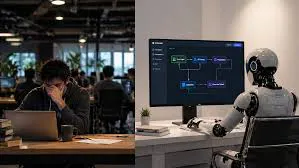
The old entry-level tech career path is breaking.
For years, the advice was simple:
Learn to code -> Watch tutorials -> Build a few portfolio projects -> Apply for junior developer jobs.
That worked when companies needed juniors to write basic code, fix simple bugs, and handle repetitive tasks.
But AI is changing that.
Today, AI tools can generate code, write tests, explain errors, build simple interfaces, and automate parts of the software development process. Companies are no longer asking only, “Can this person code?”
They are asking a better question:
Can this person use AI to build real software, solve real problems, and explain their decisions clearly?
That is the new entry-level standard.
Junior Tech Jobs Are Being Rewritten
A lot of beginners feel the same fear right now:
“Am I too late?”
“Will AI replace junior developers?”
“Is learning to code still worth it?”
“Do I need a computer science degree to compete?”
These are fair questions.
Recent hiring trends show that entry-level roles are changing. CodeSignal has launched AI-era coding assessments where candidates use tools like Claude Code, Cursor, and Codex. Airbnb said 60% of code produced by its engineers in Q1 2026 was written by AI. IBM is expanding entry-level hiring, but rewriting junior roles so new hires focus less on repetitive coding and more on judgment, customer understanding, and AI oversight.
So yes, the old junior developer role is under pressure.
But that does not mean beginners are finished.
It means beginners need to learn differently.
One Person Can Now Build More Than Ever
Here is the good news.
AI does not only help big companies. It also gives individual builders massive leverage.
A beginner today can build things that used to require a small team:
- A full-stack web app
- An AI chatbot
- An internal business dashboard
- A booking system
- A workflow automation
- A customer support tool
- A prototype for a startup idea
This is why learning tech still matters.
The opportunity has not disappeared. It has moved.
The people who win will not be the ones who avoid AI. They will be the ones who learn how to use AI properly while still understanding the fundamentals.
AI can help you move faster, but it cannot replace your judgment.
You still need to know what to build, how systems work, why errors happen, and whether the output is actually correct.
That is the difference between someone who “uses ChatGPT” and someone who is becoming a real AI builder.
What Beginners Should Learn Now
If you are starting your tech journey in 2026, do not just learn “coding.”
Learn how to build.
Here are the skills that matter most.
1. Full-Stack Web Development
Start with the foundations.
You need to understand how real applications work:
- Frontend development
- Backend development
- Databases
- APIs
- Authentication
- Deployment
- Basic security
- Version control with Git
AI can help you write code, but if you do not understand the system, you will not know how to fix it when something breaks.
And things will break.
2. AI-Assisted Coding
Modern developers are already using AI tools as part of their workflow.
That means beginners should learn how to work with tools like ChatGPT, Claude, Cursor, Codex, and other coding agents.
But the goal is not to blindly copy AI-generated code.
The goal is to learn how to:
- Give clear instructions
- Break big tasks into smaller tasks
- Review AI-generated code
- Debug errors
- Improve messy output
- Ask better technical questions
- Compare different solutions
This is becoming a core software engineering skill.
3. Debugging And Problem Solving
AI often gives answers that look confident but are wrong.
That is why debugging is more valuable than ever.
A job-ready beginner should know how to read error messages, inspect logs, test assumptions, use documentation, and isolate the real problem.
Companies do not hire people because they never get stuck.
They hire people who know what to do when they get stuck.
4. Real Project Building
Tutorial projects are not enough anymore.
A weather app, calculator, or clone app can help you practise, but they rarely prove job readiness.
Better projects look closer to real business problems:
- A CRM dashboard
- A student progress tracker
- An AI resume reviewer
- A booking and payment system
- A sales automation tool
- A customer support chatbot
- An inventory management app
Build real projects, not toy apps.
This gives you proof. And in the AI era, proof matters more than certificates.
5. Product Thinking
A strong AI builder does not just ask, “Can I code this?”
They ask:
Who is this for?
What problem does it solve?
What should the user do first?
What can be simpler?
What would make this useful in real life?
This is what separates a coder from a builder.
Companies want people who can think beyond syntax and understand the product.
6. Communication
If you want to get hired, you need to explain your work clearly.
You should be able to talk about:
- What you built
- Why you built it
- What tools you used
- What problems you faced
- How you solved them
- What you would improve next
This matters in interviews, portfolio reviews, internships, freelance work, and team projects.
Technical skill gets stronger when you can communicate it.
So, Is Learning To Code Still Worth It?
Yes.
But learning to code the old way is not enough.
If your plan is only to watch tutorials and collect certificates, you will struggle.
If your plan is to build real projects, use AI tools, understand full-stack development, and practise solving real problems, you are on a much stronger path.
The future does not belong to people who can memorise syntax.
It belongs to people who can use technology to create useful things.
The New Entry-Level Developer Is An AI Builder
The new junior developer is not just a beginner who writes simple code.
The new junior developer is someone who can:
- Understand a problem
- Build a working solution
- Use AI tools responsibly
- Debug and verify the output
- Communicate clearly
- Keep learning quickly
That is the new entry-level.
And for beginners, this is actually good news.
You do not need a computer science degree to start.
You do not need to spend four years waiting.
You do not need to learn alone from random tutorials forever.
You need structure, support, real projects, and the right modern workflow.
Learn Tech And AI The Practical Way
At Sigmaschool, we help beginners become job-ready by learning the skills that actually matter in today’s tech market.
Most courses teach theory. We build careers.
You will learn full-stack development, AI integration, project building, and the practical workflows modern developers use to ship real software.
No degree required. Real skills required.
If you want to break into tech, the best time to start was before AI changed the job market.
The second-best time is now.
Get started today, completely for free! Find out how to go from beginner to job-ready with Tech & AI.